As a society, we’ve gotten incredibly good at reacting to crises. We’ve built massive industries and dedicated entire professions to catching people when they fall. Doctors treat our physical illnesses, therapists help heal our emotional wounds, social workers step in to protect vulnerable families, and nonprofits work tirelessly to address poverty, homelessness, and addiction. Most people who enter these fields do so out of a genuine, deep-seated desire to help. The issue isn’t a lack of compassion; it’s the design of the systems they have to work within.
Economy of Problems
In a very real way, we’ve built an economy that relies on the existence of problems.
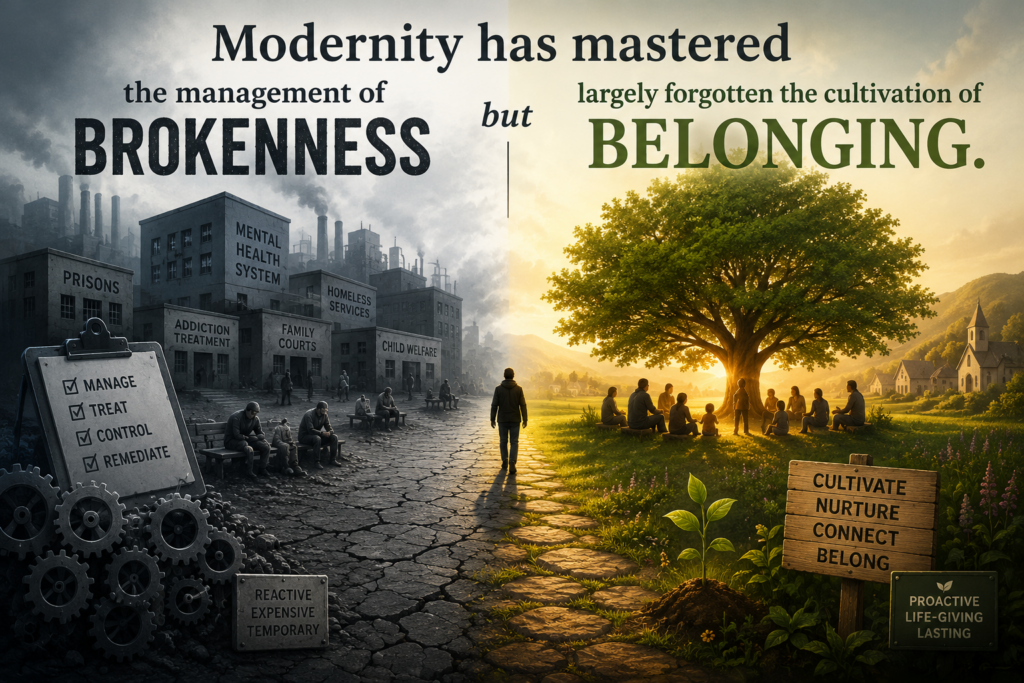
Our universities train professionals to diagnose them, governments allocate budgets to manage them, and nonprofits raise money to solve them. This isn’t a criticism of the people doing the work—it’s just an honest look at the incentives we’ve created. We have built a highly sophisticated system of intervention, but we invest very little in prevention. Resources only seem to flow once a crisis becomes visible. As a result, we’ve become experts at managing pain, while ignoring the very conditions that cause it to take root in the first place.
The Upstream Question
In public health, there’s a well-known concept of going “upstream” to find the root cause of an illness rather than just treating the symptoms. We need to ask the same question about our social fabric.
What if our most persistent struggles—addiction, isolation, violence, and the deep-seated despair so many feel—aren’t just individual failures? What if they are actually downstream symptoms of fractured belonging? If that’s true, our core question shouldn’t be, “How do we manage these crises?” It should be, “How do we build the kinds of families, neighborhoods, and communities where people feel deeply rooted and valued from the start?”
Wholesale and Retail
Our large institutions are built for “wholesale” solutions. They are designed to scale, process data, allocate budgets, and deliver services to vast populations. We certainly need them, but you cannot scale human connection.
Belonging is entirely “retail.” It happens slowly, one-on-one, in the quiet spaces of everyday life. It’s found in a family dinner, a reliable friendship, a neighbor who checks in, or a community that welcomes you exactly as you are before asking you to prove your worth. This is the heart of what it means to cultivate belonging: it’s not something you can mass-produce. It can only be nurtured, one relationship at a time.
Programs or Movements?
Because we live in an industrialized world, our default setting is to build a program. Programs are naturally obsessed with metrics: “How many people did we serve? What was the cost per client? What are the measurable outcomes?”
These metrics matter, but they don’t capture the whole story. Movements, on the other hand, ask entirely different questions: “Who is learning how to love their neighbor? How many broken relationships were restored? Are our communities becoming places where people feel safe and valued?” Programs deliver services, but movements transform people.
Learning from Jesus
We can see this relational blueprint in the life of Jesus. He didn’t start by building a massive institution or drafting organizational bylaws. Instead, he gathered a small group of people, poured his life into them, and trusted them to do the same for others. It was an organic, relational approach rather than an industrial one, spreading through genuine connection rather than mass distribution.
There’s nothing inherently wrong with organizations or structures—they often do vital work. But every institution faces a quiet temptation: over time, preserving the organization can become more important than fulfilling the actual mission. We have to constantly ask ourselves: “Are we actually fostering real connection, or are we just managing the loneliness around us?”
A Different Measure of Success
This perspective isn’t about getting rid of professional help. We will always need doctors, therapists, social workers, and teachers. But we need to shift our cultural goalposts from merely managing deficits to actively cultivating good.
True success shouldn’t just be measured by a drop in crisis statistics, but by an abundance of connection: stronger families, trustworthy neighborhoods, and spaces where people feel secure. These aren’t just warm, sentimental ideas; they are the very foundation of a healthy, resilient society.
From Intervention to Cultivation
Ultimately, the future of care isn’t just about better crisis management; it’s about rediscovering the art of cultivating community. Instead of just picking up the pieces of broken lives, we need to build environments where people can truly thrive.
That shift changes everything. It moves us from institutional dependence to real, lived relationships, and from programs that serve people to movements that form them. Belonging cannot be outsourced to a system. It has to be lived out, day by day, one person at a time.