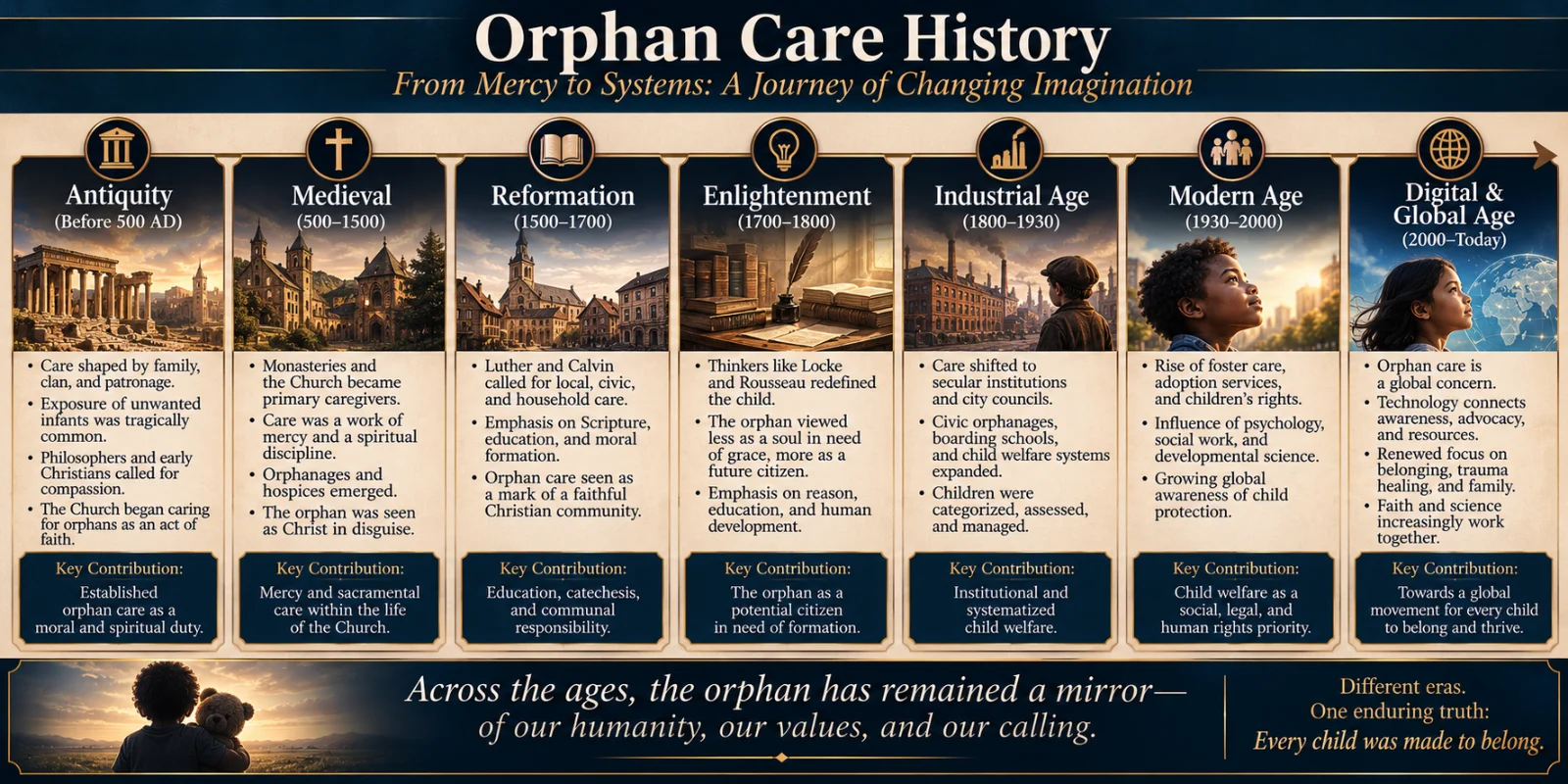

Why the orphan may be the key to understanding the human story.
Every civilization tells the story of the orphan.
Moses is placed in a basket and sent down the Nile. Oedipus is abandoned at birth. Romulus and Remus are left to die. Esther loses her parents but rises to save her people. Superman is sent from a dying planet. Harry Potter grows up unwanted, unaware of his identity and inheritance.
Different centuries. Different cultures. Different stories.
Yet beneath them all is a remarkably consistent narrative: Someone is separated from their origins, struggles to discover who they are, and searches for a place where they belong.
Why does humanity keep telling this story? Perhaps because, in some profound sense, it is our story.
The Orphan as a Universal Archetype
The orphan is more than a child without parents. As an archetype, the orphan represents something deeply embedded in the human experience: the fear of being unwanted, the uncertainty of identity, and the longing to be known, protected, and received.
We do not have to experience literal abandonment to recognize these feelings. We can grow up in families and still feel unknown. We can live in communities and remain disconnected. We can achieve success and recognition while privately wondering whether we truly matter.
The orphan’s question is not simply, Who will take care of me? It is something more fundamental: Where did I come from? Who am I? To whom do I belong?
These are not merely the questions of abandoned children. They are questions of human existence.
The Orphan as the Human Meta-Narrative
What happens when we stop seeing the orphan merely as a character in a story and begin seeing orphanhood as a lens through which to understand the world?
An entirely different picture emerges.
Theologically, orphanhood reflects humanity’s estrangement from its Creator and the biblical movement toward reconciliation, adoption, and restoration.
Psychologically, it reveals how identity develops amid loss and insecurity, and how people can construct identities around survival rather than security.
Sociologically, the orphan exposes how societies determine who belongs, who is protected, and who remains outside. The treatment of the orphan becomes a mirror reflecting a civilization’s understanding of human dignity.
Biologically, early relational experiences shape developing systems of safety, stress, and connection. The body can carry the consequences of relational disruption long after the circumstances have changed.
Cognitively, the orphan’s journey reveals how experiences of rejection become beliefs about identity—and how healing can involve reframing those beliefs.
Anthropologically, the orphan exposes fractures in kinship and community, revealing why societies construct institutions and systems of care when natural relationships fail.
Across these disciplines, a common thread emerges: The human story is not merely about survival. It is about belonging.
When Rupture Becomes Structure
Here is where the orphan’s story becomes especially important. When disconnection persists, it does not necessarily remain an isolated experience. It can shape identities, relationships, families, and eventually institutions.
What begins as rupture becomes structure.
The child who learns that relationships are unreliable may become an adult who struggles to trust. Families can transmit unresolved wounds across generations. Communities can normalize the very conditions that produce alienation. Eventually, we may stop recognizing the original wound because we have become accustomed to the structures built around it.
This is why the orphan is not simply a subject for charity or compassion. The orphan offers a way of understanding civilization itself. Our systems of government, education, religion, and social care can be examined through one fundamental question: Do they restore the conditions for human belonging, or merely manage the consequences of its absence?
The Story of Return
Yet the great orphan stories rarely end with abandonment. They move toward discovery, identity, purpose, and home. Perhaps that is why these stories endure. They speak to something humanity has never stopped seeking.
We are not simply searching for independence, achievement, or happiness. We are searching for belonging. And perhaps the deepest truth hidden within the orphan archetype is this:
Belonging is not something humanity invented to compensate for its brokenness. It is something for which humanity was created.