From Orphanhood to Chosenhood
Belovedness as Identity and Vocation
1 John 3:1
“See what great love the Father has lavished on us, that we should be called children of God!
And that is what we are!”
We began with a wound—a fracture. We began with a name that was lost before it was fully formed. We call this orphanhood—not only as a legal status or a particular trauma, but as a condition of the soul and a psychological structure of survival.
We traced the scaffolding the orphaned self builds when belonging is uncertain or unsafe:
- rupture,
- displacement,
- fragmentation,
- adaptation,
- false identity.
Each of these is a strategy to stay alive when love feels unreliable.
Then we began the journey of returning to our origin. Layer by layer, we unbuilt the scaffold. We told the truth about our disconnection. We stood in the doorway of the Father’s house—not because we had finally perfected ourselves, but because we finally stopped running.
In Chapter 8, we crossed that threshold. We returned. We came home—not through performance, but through presence. But that is still not the end. Coming home is not the conclusion of the story; it is the beginning of a new one.
Now the question confronts us: What will we do with it?
From Being Received to Being Entrusted
To answer that question, we need language that goes beyond adoption: chosenhood.
Adoption is the act; chosenhood is the identity.
Adoption brings us into the family; chosenhood is the way we live within it.
To be adopted is to be received. To be chosen is to be entrusted.
Adoption restores relationship. Chosenhood activates vocation
Adoption heals the wound of being unclaimed. Chosenhood names the calling of the beloved: not just to be safe, but to become someone who embodies safety for others. Adoption says, “You may come in.” Chosenhood says, “Now that you are in, your life is given a purpose.”
If orphanhood was a five-layer structure of survival, then chosenhood is a five-layer foundation of secure belonging and purposeful living. Each truth you learn about being chosen tears down a lie you learned about being an orphan. This isn’t just about healing old wounds. It’s about becoming fully alive. You weren’t just saved from something. You were chosen for something.
Identity Before Mission
Winship writes, “Identity is not discovered by looking within. It is revealed by the One who created you.” This simple line names what the orphaned heart cannot yet believe: that we don’t have to perform or prove our identity—we just need to receive it.
Winship’s practice of asking in prayer, “God, who do You say I am?” offers a disruptive and healing invitation. In a culture built on comparison and self-invention, this is an acceptance sonship and daughterhood. When identity comes from the voice of the Father rather than the judgment of the crowd, we are freed from the exhausting scaffolding of performance-based faith.
We are not self-made. We are God-named. And that naming changes everything.
But let’s be honest: many of us had to become self-made just to survive. The orphan self got us here—scrappy, resilient, adaptive. It found a way to protect us when no one else did. And for that, it deserves a kind of gratitude. But it can’t take us any further. Chosenhood is not a rejection of what kept us alive; it’s the invitation to live from a deeper truth. The self-made built the scaffolding. The God-named gets to come out and live in the open.
This is the pattern we see in Jesus. He did not begin His ministry with an achievement. He began with an affirmation: “You are my beloved Son, in whom I am well pleased” (Mark 1:11). Before miracles, before sermons, before the cross, there was identity. Before Jesus did, He was. And that identity—belovedness—was not just security; it was commission. The Spirit descended, and Jesus was sent.
As Henri Nouwen so aptly reminds us, “Jesus was called the beloved before he had done anything. That’s our starting point too.”
We do not earn our calling. We receive it in the same way Jesus received His—through presence, through listening, through standing still under the voice of the Father. The call of chosenhood is not, “Go prove you’re worth it.” It is: “You are already mine. Go live like it.” Any version of calling that begins with pressure instead of belovedness is a counterfeit.
A Life That Becomes a Gift
Chosenhood is not spiritual elitism—it is a spirituality of trust. To be chosen is not to be superior; it is to be trusted with grace. Israel was chosen—not to hoard holiness, but to be a blessing to the nations. Jesus was chosen—not to escape pain, but to enter it for our sake. The Church is chosen—not to be a gated community, but to embody God’s reconciling presence in the world.
The chosen are not those who climb a ladder, outpacing others in spiritual performance. They are those who remain rooted in grace—deeply, steadily, for the sake of others. Chosenhood means we no longer treat grace as a private possession, but as a trust we are accountable to steward in our homes, workplaces, churches, and neighborhoods.
To live as chosen is to reject the inner narrative that says, “You must keep earning your worth. You must never fail. You must protect your place.” Those sentences sound normal in an orphaned culture, but they are lies. Chosenhood reverses the lies:
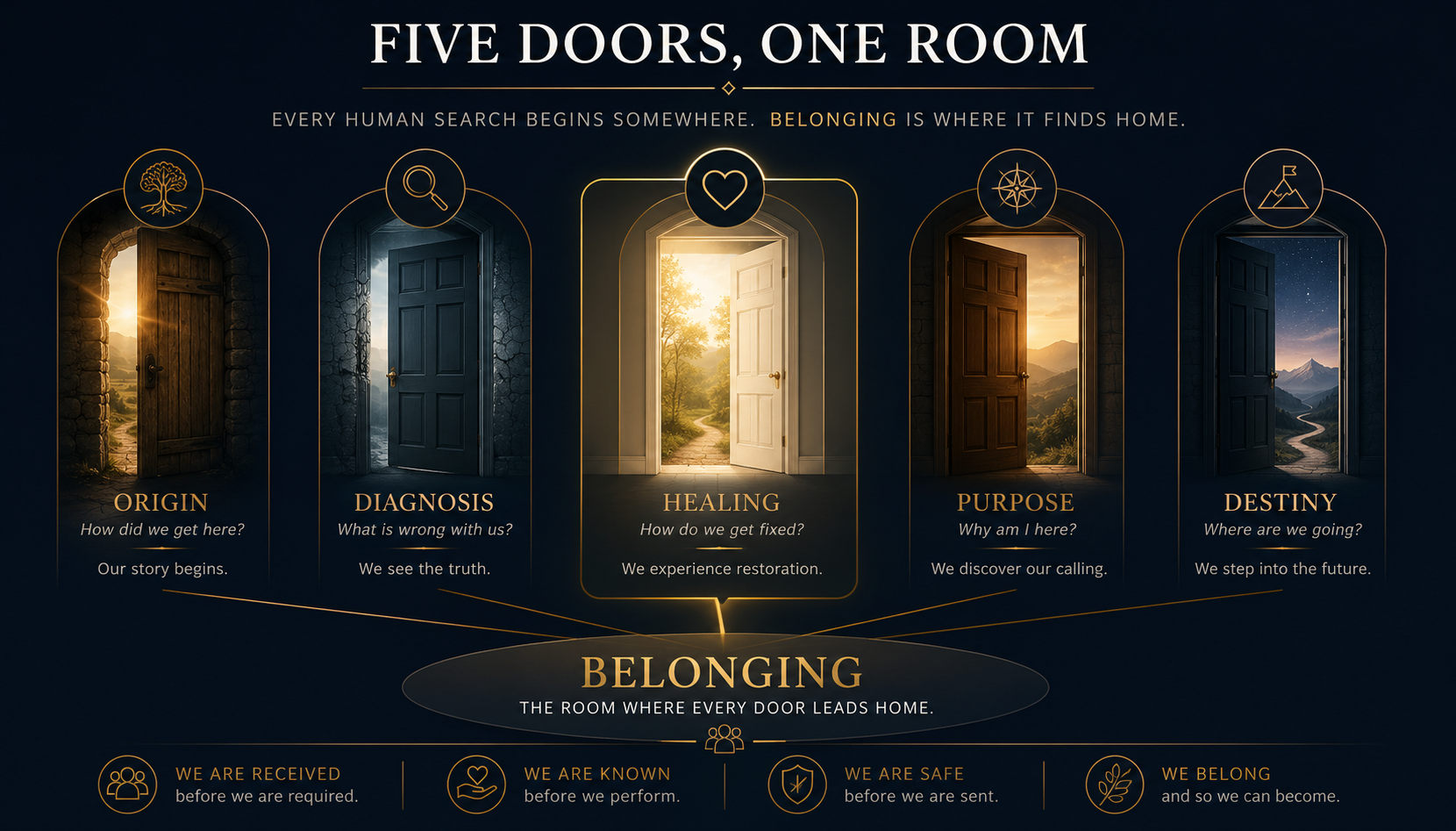
You belong before you behave.
You are safe even when you struggle.
You are loved even when you’re sent into hard places.
This reversal is disruptive. It confronts the habits of anxiety, comparison, and self-protection that have ordered our lives. It calls us to repent of the ways we have tried to secure for ourselves what God has already given freely.
Seen this way, chosenhood becomes vocation.
Vocation is not your job. Vocation is the way your life becomes a gift. Parker Palmer reminds us that “vocation does not come from willfulness. It comes from listening.” In this sense, chosenhood is the courageous act of living from your truest self. It is how your presence, your story, your wounds and your healing all become available to others under the rule of love.
When we live from this place, just being around us can feel like a homecoming for other people. Our bodies are less on edge, not so driven by fear or the feeling that there’s never enough. Our words come more from the heart because we’re less worried about managing our image. Our relationships become places of rest instead of stages for performance and competition.
Living like this doesn’t mean we pull back from the world’s pain. It means we turn toward it—not as a fixer who needs to control the outcome, but as someone who stays, who pays attention, and who simply refuses to walk away.
The Circle of Chosenhood
Developmental psychologists describe secure attachment through what is known as the Circle of Security—a simple but profound model of care. In this framework, a healthy caregiver provides two essential gifts: the freedom to explore and the safety to return. The caregiver remains present at both points—delighting in the child’s movement outward and receiving them without judgment when they come back for comfort, reassurance, or repair. This isn’t about being permissive or trying to control them; it’s all about providing a steady, secure presence they can count on.
Seen through the lens of chosenhood, the Circle of Security reveals something deeply theological. It shows us what the orphaned heart lacked, and what the Father has always offered. Orphanhood forms when there is no safe place to land, no steady presence to return to, no assurance that failure or fear will be met with care rather than withdrawal. The orphan learns to explore alone and to return cautiously, if at all. Chosenhood restores the circle. It says: You are free to go, and you are safe to come back.
This is why people who feel truly chosen can be such a gift. When you’re secure in yourself, you can be present with others without all the anxiety. You no longer feel the need to fix, manage, or control the people you love. You can simply hold space for them. You can celebrate their courage for taking a risk, no matter the outcome. You can sit with their pain without making them feel ashamed. You can be the one who stays when others walk away. In this way, chosenhood isn’t just an internal experience—it’s a way of being with people that helps calm their deepest fears and rewrite the old story of abandonment.
The Circle of Security also explains why our vocation must flow from our belovedness. The Father sends us into the world not to earn our place, but because our place is secure. And when the work is heavy, when the world wounds, when the mission costs more than expected, the circle remains intact. We are not sent away—we are sent from love, and always back to it.
Two Scaffolds, Two Stories
Here is how the movement from orphanhood to chosenhood unfolds. Don’t think of it as a chart, but as a map. It names where many of us have been living and where we are being invited to go.
| Orphanhood | Chosenhood |
| Rupture (relational break) | Reconnection (adopted by the Father) |
| Displacement (loss of place) | Rootedness (secure in communion) |
| Adaptation (living as a false self) | Integrity (living as the true self) |
| Fragmentation (disintegrated identity) | Integration (a whole identity) |
| False Belonging (performance-based acceptance) | Covenant Belonging (presence over performance) |
The Church as a Training Ground for Chosenhood
The Church, then, has to be the training ground for chosenhood. It must be a space where we can name our wounds without shame and where our identity is built on grace, not on how good we are. A place where presence matters more than platforms, and faithfulness outweighs programming.
In a church like that, pastors aren’t performers and members aren’t consumer. Leaders don’t build brands; they cultivate community. The communion table is not a reward for the successful, but a reminder for the dependent.
A Church that understands chosenhood does not exist to protect its reputation; it exists to embody God’s welcome. It does not hide its brokenness; it testifies to God’s mercy in the midst of it. Chosenhood doesn’t make us safe people, sealed off from risk and hurt. It makes us sent people—a people willing to go wherever love requires.
We live, sadly enough, in a still-orphaned world. The world around us still carries the scaffold. The systems still create orphans. The culture still tells us to prove and protect and produce. Every day, the old invitations return: hustle, harden, hide.
But the chosen one does not live in reaction. The chosen one lives in response to grace. You are no longer just unlearning your orphan reflexes; you are now learning and practicing your chosen rhythms. Chosenhood means you respond to accusation with gentleness, to power with humility, to difference with covenant, to fear with presence. It means your first question is no longer, “How do I stay safe?” but “What does faithfulness look like here?”
The Shepherding Church
If chosenhood is the identity of the beloved, then shepherding is the posture that sustains it. Scripture does not imagine the people of God being formed primarily by managers, administrators, or moral enforcers. It imagines them being gathered by shepherds. The shepherding model is the leadership language of chosenhood because it is built on presence, not performance; relationship, not regulation.
Jesus describes Himself this way: “I am the good shepherd. I know my own and my own know me” (John 10:14). Knowing precedes leading. Naming precedes sending. In contrast to orphaned systems—where people are managed, sorted, and evaluated from a distance—the shepherd lives among the flock. He stays. He notices. He protects without controlling and guides without coercing.
The shepherd does not drive sheep forward with fear; he leads them by voice.
This model stands in direct opposition to what we have called the substitute father—systems that provide without presence, regulate without relationship, and discipline without love. Orphaned leadership relies on distance, data, and domination. Shepherding leadership, on the other hand, is all about nearness, discernment, and service. One gets you compliance, but the other is how you build trust.
A shepherding church, then, is not defined by its efficiency or its size, but by its capacity to remain. Pastors are not brand managers, and people are not problems to be fixed. Instead, the church becomes a place where the orphan logic slowly loses its grip because it is consistently contradicted by embodied faithfulness. People are known by name. Stories are remembered. Struggles are not rushed to resolution. Presence is not withdrawn when someone falters.
Eugene Peterson warned that when pastors become brand managers, the Church becomes a business and not a body. Shepherding leadership, he argued, is about presence, not polish.
This is how chosenhood becomes practiced rather than preached.
In a shepherding church, belonging is not earned by agreement or usefulness. It is reinforced through repeated experiences of safety: being seen without being exposed, corrected without being shamed, sent without being abandoned. Over time, this kind of leadership retrains the nervous system. It teaches the orphaned heart that authority does not always wound, that guidance does not always cost belonging, and that love can coexist with truth.
A true shepherding church isn’t trying to replace the Father, just reflect Him. It doesn’t claim to own the flock; it simply points to the Shepherd who does. And in doing that, it becomes what this lonely world needs most—not another system to survive in, but a living, breathing sense of home.
A Turning Point
In the chapters to come, we will ask:
How do chosen people live in a morally compromised world?
How do chosen people hold steady in a fragmented, orphaned culture?
How do we walk, not simply as recovering orphans, but as remembered sons and daughters of the High King?
Here, at this turning point, we pause—not to prove, not to strategize, but to simply remember that we are loved.