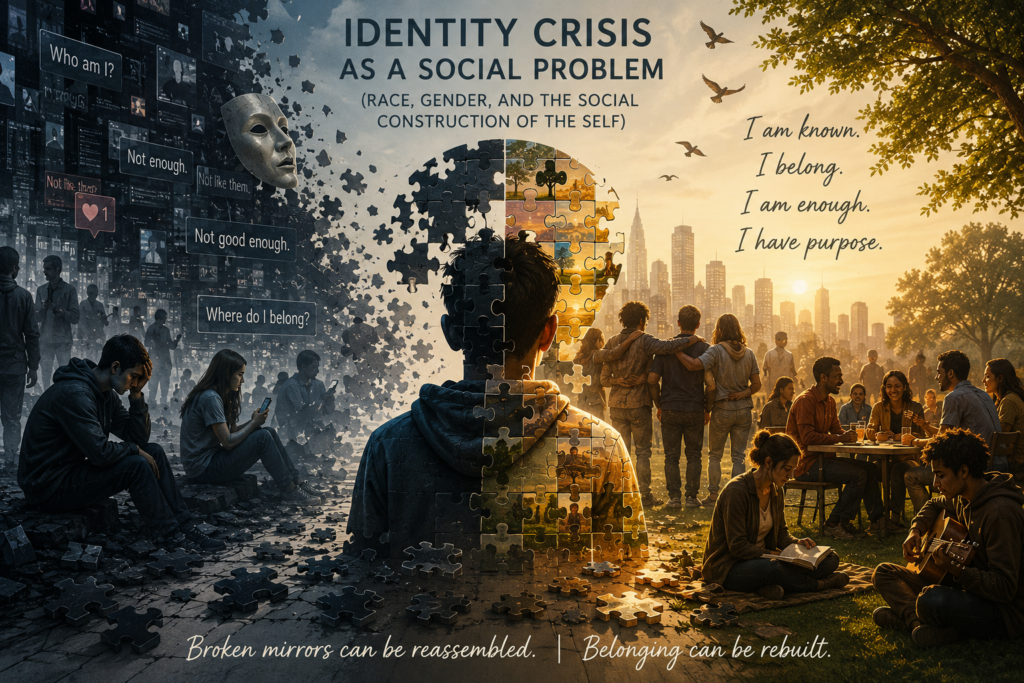
(Race, Gender, and the Social Construction of the Self)
We don’t know who we are anymore.
Sociologists have been describing this for decades in neutral terms—identity unsettlement, late-modern self-fragmentation, hyper-individualism.
Today, we’ll look at identity crisis not just as a personal struggle, but as a social problem—a condition produced by cultural forces, economic pressures, technological change, and our collective failure to offer people a stable place to belong.
1. What is Identity as a Social Construct?
Sociology has long held that identity is not something we discover like buried treasure; it is something constructed. It emerges through interaction, language, norms, institutions, and the meanings we absorb from the world around us.
Race and gender are two of the clearest examples:
- Race is not rooted in biology but in social meaning—categories built through law, power, and history. The body has skin, but society assigns hierarchy.
- Gender is not merely anatomy; it is a patterned set of expectations about behavior, appearance, desire, roles, and worth—learned, enforced, and policed through institutions.
Identity, then, is negotiated. It is never simply “who I am,” but who I am in relation to others.
Conclusion: Identity is fragile when belonging is fragile.
2. What Is the Contemporary Identity Crisis?
The modern crisis is not that identity is constructed—this has always been true. The crisis is that the institutions that once stabilized identity have eroded.
Sociologists point to several forces:
Digital life.
Online spaces detach identity from embodied community. You can be endlessly curated but never truly connected.
Fragmentation of institutions.
Family structures, religious communities, neighborhood networks, and civic associations—our old identity-bearing systems—are weakened.
Hyper-individualism.
The message of late modernity is: “You are responsible for inventing yourself from scratch.”
That is exhilarating until it becomes suffocating.
Performative culture.
Worth is signaled, not lived. Identity becomes a performance evaluated by invisible audiences.
Crisis of belonging.
We do not simply wonder who we are; we wonder where we belong.
From the voice of the recovering orphan, this feels eerily familiar.
It sounds like the child who learned to survive by constructing self instead of receiving self.
Our culture is reenacting that wound at scale.
3. Why Is This a Social Problem?
Identity crisis becomes a social problem when its effects ripple across communities, generations, and institutions.
A crisis of stability.
People without a grounded sense of self struggle to build lasting relationships, communities, and commitments.
A crisis of empathy.
When identity is unstable, others become threats to our fragile sense of meaning. Polarization rises not only from ideology but from insecurity.
A crisis of mental health.
Anxiety, depression, body dysmorphia, social comparison loops—these are not private disorders but social symptoms.
A crisis of trust.
Society depends on shared meaning. When identity becomes fragmented and competitive, common ground erodes.
4. How Are People Coping with the Identity Crisis?
People reach for identity with the same urgency a drowning person reaches for air.
Here are the primary coping strategies sociologists observe:
Performance-Based Identity
Crafting a persona through achievement, activism, aesthetics, or online branding. Worth becomes a scoreboard.
Affirmation-Based Identity
Seeking constant validation from peers, groups, or online audiences. Identity becomes externally supplied and easily revoked.
Group Absolutism
Fusion with tight ideological or subcultural tribes. “I belong because I agree.” Belonging becomes conditional on conformity.
Escapist Identities
Reinvention through fantasy, online avatars, or radical self-curation. The self becomes experimental rather than inhabitable.
Identity Maximalism
Treating identity categories as the deepest truth about the self—race, gender, sexuality, politics.
These categories matter profoundly, but when they become totalizing, the person disappears into the label.
These are not failures. They are survival strategies—fig leaves constructed by a society that has forgotten how to name its children.
5. How Do We Solve the Identity Crisis?
A social problem requires social solutions. Identity cannot be healed purely through private introspection because identity was fractured communally. Identity stabilizes when belonging stabilizes.
Here are the sociological pathways forward:
1. Rebuild systems of belonging.
Identity grows roots in stable, trustworthy communities—family, neighborhood, school, congregation, mentorship. Where people feel seen, identity becomes less performative and more grounded.
2. Restore narratives bigger than the self.
Modern self-invention is exhausting. People need communal stories of meaning—moral frameworks, shared symbols, histories, and collective purpose.
3. Teach identity literacy.
Students need tools to understand:
- social construction
- emotional regulation
- media literacy
- relational trust
- the difference between expression and authenticity
This turns identity from a battlefield into a learning space.
4. Create spaces for embodied, not digital, connection.
You cannot build a stable sense of self in an environment built for comparison and disembodiment.
5. Foster rituals of grounding and belonging.
Humans need patterned practices that reinforce who they are—rituals of community meals, shared reflection, rites of passage, service, forgiveness, reconciliation.
6. Recover the concept of bestowed identity.
Not in a theological sense in the classroom, but in a sociological sense: Identity gains stability when it is not earned but received—through consistent affirmation, reliable relationships, and social mirrors that reflect dignity rather than scarcity.
In simple terms: A society heals identity the same way a parent heals a frightened child—through presence, consistency, and truthful naming.
Final Note
If race and gender are socially constructed, then so is every role, identity, and performance we inherit. That can feel destabilizing, even frightening.
But if identity is constructed, it can also be reconstructed. Broken mirrors can be reassembled. Belonging can be rebuilt. And a society that forgot the art of naming can learn again.
The crisis is real, but so is the possibility.