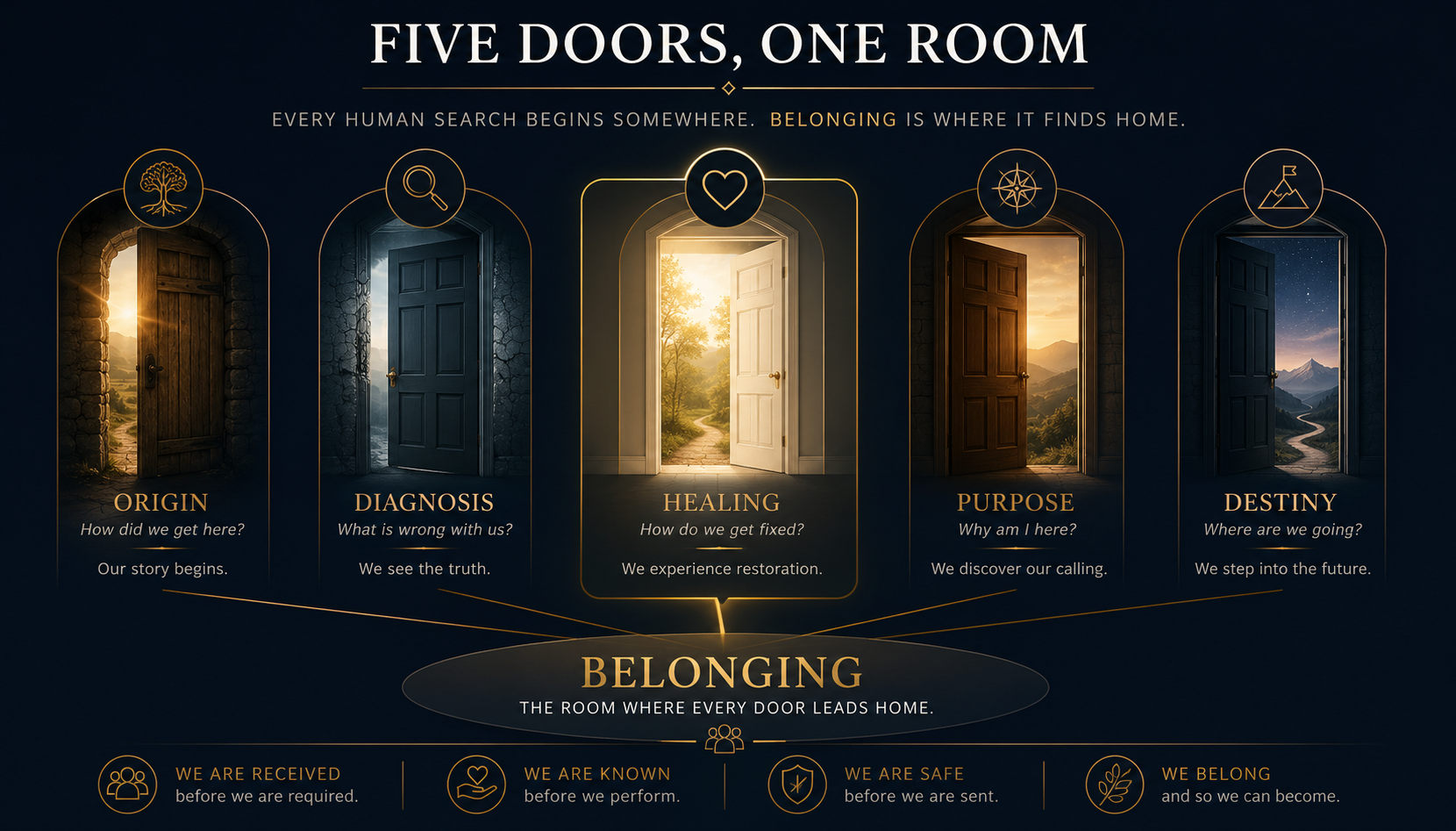
Every human search begins somewhere. Belonging is where it finds home.
“And He has made from one blood every nation of men to dwell on all the face of the earth… so that they should seek the Lord, in the hope that they might grope for Him and find Him, though He is not far from each one of us.” — Acts 17:26–27 (NKJV)
Every human being, regardless of culture, religion, or generation, eventually confronts five fundamental questions:
- Origin: How did we get here?
- Diagnosis: What is wrong with us?
- Healing: How do we get fixed?
- Purpose: Why am I here?
- Destiny: Where are we going?
Every worldview attempts to answer these questions. Religion, philosophy, psychology, and sociology approach them from different perspectives.
But what if these are not five separate searches? What if they are five doors leading into the same room?
That room is belonging.
We want to know where we came from because we long to understand whether we were meant to be here. We want to know what went wrong because something within us recognizes that life is not as it should be. We seek healing because we long for restoration. We search for purpose because we want our lives to matter. And we wonder about destiny because we hope our existence leads somewhere meaningful.
Beneath these questions lies a common human longing: to be known, wanted, secure, and connected to something greater than ourselves.
Yet we enter a world already shaped by relationships, histories, cultures, and institutions we did not choose. Some of these environments nurture belonging. Others teach us to survive its absence.
We adapt. We build defenses. We learn to perform, withdraw, control, or please. And over time, these adaptations can become so familiar that we mistake them for who we are.
What begins as rupture becomes structure.
This is where Chosenhood and Belonging meet.
Chosenhood: You Are Not What You Had to Become explores how individuals can recover their created identity beneath the adaptations they developed to survive.
Belonging: We Are Not What We Had to Become Together extends that discovery to our families, communities, institutions, and cultures.
Just as individuals adapt to broken belonging, entire societies develop structures around collective wounds. What one generation builds to survive can become the environment the next generation inherits.
But neither our personal adaptations nor our collective structures have to determine our future.
We can recover what was lost, repair what was broken, and rebuild the places that shape those who come after us.
The Christian story begins with humanity created for relationship and ends with the promise of God dwelling with His people. From Genesis to Revelation, belonging is woven through the story of creation, estrangement, reconciliation, and restoration.
Perhaps that is why these five questions continue to follow us across every generation. We are searching for more than explanations. We are searching for home.
We are received before we are required. We are known before we perform. We are safe before we are sent. We belong, and so we can become.
Five doors. One room.
And the remarkable possibility is that the belonging we have spent our lives searching for was never meant to be something we had to earn.