We have become remarkably good at punishing people for what they do. But have we become equally good at understanding what happened to them before they did it?
Our criminal justice system is built to respond to wrongdoing. We investigate, arrest, prosecute, sentence, and incarcerate. We have developed enormous institutions and entire professions devoted to maintaining law and order.
And we need them. A society without accountability cannot protect its people.
But I wonder if we have become so focused on responding to criminal behavior that we have forgotten to examine the conditions in which that behavior takes root.
What if some of what we call criminal justice is actually the management of broken belonging?
Belonging Systems Theory (BST) begins with a simple premise: no one develops in isolation. We are shaped by families, neighborhoods, schools, relationships, and institutions. These form the invisible architecture upon which our lives are built.
When that architecture is secure, it can support healthy development. When it is fractured, the consequences can reach far beyond the individual.
What begins as rupture becomes structure.
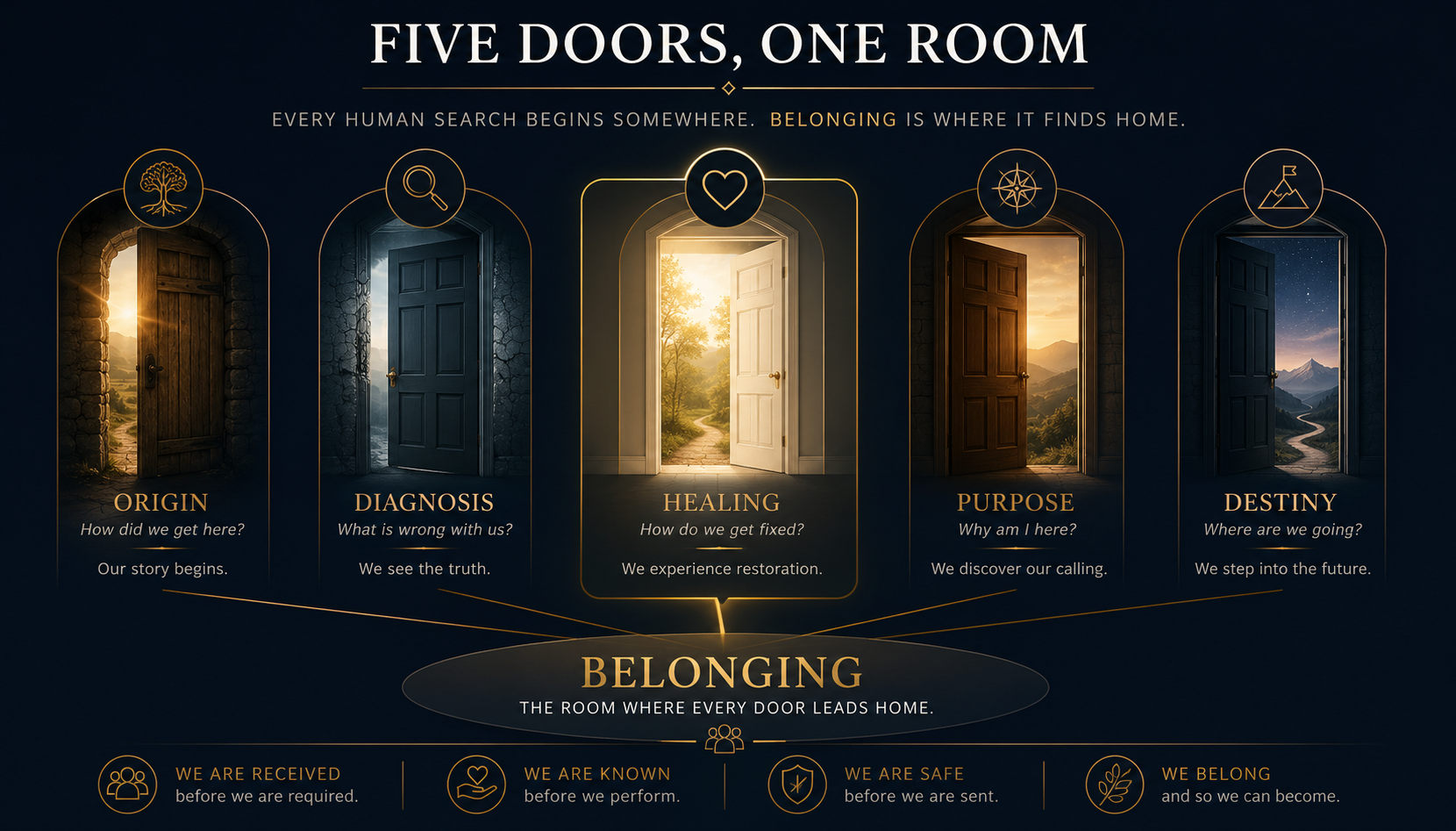
This raises five questions I believe we need to ask.
1. Before the Crime: What Happened to This Person?
We are quick to ask what someone did. We are less inclined to ask what happened before they did it.
What kind of home did they grow up in? Who protected them? Who taught them they mattered? Where did they learn responsibility, trust, and self-control?
Some people grow up surrounded by security and opportunity. Others grow up learning to survive in environments marked by fear, instability, rejection, or violence.
Neither circumstance determines a person’s future. People who have suffered greatly can make remarkable choices, just as people who have been given every advantage can make destructive ones.
Human agency endures.
But choices do not happen in a vacuum. Before we can understand behavior, we should understand something about the architecture in which it was formed.
2. During the Crime: What Was This Person Seeking?
Not every crime is an attempt to belong. Greed, anger, opportunity, and countless other motivations influence human behavior.
But consider the young person who joins a gang.
We see criminal association. They may see protection, identity, acceptance, and a family they never had.
The behavior may be destructive, but the underlying longing is deeply human.
When healthy belonging is absent, people may seek its counterfeit.
This doesn’t excuse wrongdoing. It helps us understand why punishment alone may not change the behavior.
If we remove someone from a destructive group without helping them discover a healthier place to belong, have we addressed the problem—or simply interrupted it?
3. During Punishment: Are We Correcting Behavior or Creating Identity?
Accountability matters. Victims deserve justice. Communities deserve protection. Wrongdoing must have consequences.
But somewhere between conviction and incarceration, something else can happen.
A person who committed a crime becomes a criminal. An action becomes an identity.
And sometimes that identity follows them for the rest of their lives.
We should ask whether our methods of punishment encourage responsibility and change or reinforce the very identities and patterns we hope people will leave behind.
There is a difference between telling someone, “What you did was wrong,” and telling them, “Wrong is what you are.”
Justice must confront wrongdoing without forgetting the humanity of the wrongdoer.
That distinction matters for victims, offenders, and the communities to which many will eventually return.
4. After Punishment: Is There Anywhere to Belong?
Here is one of the great contradictions of our criminal justice system.
We release people from prison and tell them to become productive, law-abiding citizens.
Then we make it difficult for them to find employment, secure housing, rebuild relationships, or regain the trust of their communities.
They have served their sentence, but their punishment continues.
Of course, rebuilding trust requires responsibility, changed behavior, and time. Some restrictions are necessary to protect others.
But if we expect people to live differently, shouldn’t we also create meaningful opportunities for them to do so?
We cannot demand reintegration while practicing permanent exclusion.
A person can be released from prison without ever being received back into society.
And there is an enormous difference between being released and belonging.
5. Across Generations: Are We Breaking the Cycle or Building Another One?
Perhaps the most troubling question is what happens to everyone else.
When a parent goes to prison, a child may lose more than a parent’s physical presence. A family may lose income, stability, security, and connection.
The consequences can travel through relationships and across generations.
Not every child of an incarcerated parent will experience these outcomes. But when instability is repeated across families and communities, it can become something larger than an individual problem.
This is where the sociological imagination becomes essential.
What we see as personal failure may sometimes be connected to patterns of social and institutional failure.
A wound repeated enough times becomes a wall.
And eventually, people stop asking what caused the wound. They simply accept the wall as part of the landscape.
What begins as rupture becomes structure.
The question is whether our criminal justice system is helping dismantle those walls or unintentionally building new ones.
Justice Must Look Upstream
None of this means we should abandon punishment, excuse criminal behavior, or diminish the suffering of victims.
Quite the opposite.
A healthy society must protect people, establish boundaries, and hold individuals responsible for their choices.
But justice cannot be measured only by how many people we arrest, convict, or incarcerate.
We should also ask how many families are becoming stronger, how many communities are becoming safer, how many people are rebuilding their lives, and how many children are growing up with the security and relationships they need.
We have built sophisticated systems for responding to broken behavior. Perhaps it is time to become equally serious about building the conditions that help prevent it.
Belonging cannot be manufactured in a courtroom or delivered through a government program. It is built in homes, neighborhoods, churches, friendships, and communities—one relationship at a time.
Invisible belonging governs visible civilization.
And that brings us to a question larger than criminal justice itself.
Are we content to keep managing the consequences of broken belonging, or are we willing to examine and rebuild the architecture that produces them?
Because the goal should never be merely to return someone to society.
It should be to help build a society worth returning to.